
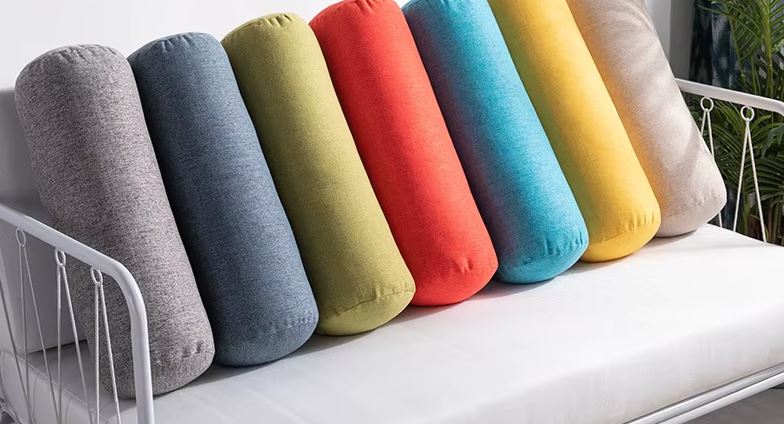
Yoga Bolster


A yoga bolster looks a bit like a large cushion. But it is much more structured than the sort you would have on a sofa. It can be placed under the knees, behind the back or beneath the upper body during floor-based yoga.
Round or Rectangular?
A rectangular bolster has flat sides and a broad surface. It stays where you place it and is easy to stack with other equipment.
A round bolster has a curved shape, a little like a long firm cushion. It can roll slightly on a wooden floor, although this is less noticeable when it is placed on a yoga mat.
There is no right shape for everyone. Some people prefer the flat surface of a rectangular bolster. Others like the feel and appearance of a round one.
The measurements are worth checking before you order. A bolster can look fairly small in a product photograph, especially when it is shown in a large studio.
Where Can a Bolster Be Placed?
A bolster can be used in several positions during yoga. It may be placed beneath the knees, hips or upper body, depending on what you are doing.
Take a moment to arrange it before settling into position. If the bolster feels too high, too low or uneven, move it rather than trying to make the position work.
Different shapes will sit differently beneath the body. A round bolster has a curved surface, while a rectangular one gives you a flatter area to lean against.
What Is Inside?
The filling can vary between bolsters.
Some feel tightly packed and hold their shape firmly. Others have a little more give when weight is placed on them. Two bolsters with similar measurements can still feel different because of the filling and the way the inner cushion has been made.
Where the information is available, check the product page for details about the filling. Photographs alone will not always show how firm the bolster is.
Some designs may soften slightly with regular use. This is normal, although a bolster that has become badly flattened or uneven may need reshaping or replacing.
Covers and Fabrics
Bolster covers come in plain colours, patterns and different types of fabric. Some feel smooth, while others have a heavier woven or textured finish.
Many bolsters have a removable cover with a zip. Others are made as one complete piece, so the cover cannot be taken off separately.
Have a close look at the photographs if a removable cover is important to you. The zip may be hidden along the side or underneath the bolster.
A carrying handle is another useful detail to check. Some bolsters have one handle at the end, while others have a handle at both ends. Not every design includes one.
Taking a Bolster to Class
A bolster is larger than most yoga props. It can be a little awkward to carry along with a mat, blocks and a bag.
Smaller bolsters are easier to take in the car or on public transport. A long, heavily filled bolster may be better kept at home unless you have a large equipment bag.
Check the weight as well as the dimensions. A bolster may not look especially heavy, but carrying it any distance can feel different once you also have the rest of your kit with you.
A handle makes it easier to move from room to room, although it may not be enough for a longer journey. Some people use a separate bolster bag where one is available.
Cleaning Your Bolster
Always check the care label before washing the cover.
A removable cover may be suitable for a gentle machine wash, although this will depend on the fabric. Some covers may need to be hand washed or cleaned with a damp cloth instead.
Do not put the whole bolster into a washing machine unless the product instructions clearly say that this is allowed.
Our collection includes round and rectangular yoga bolsters in different sizes, colours and fabrics. Check the measurements, filling, cover and handle details on each product page before choosing.
Checking the Seams and Zip
The seams around the ends of the bolster are worth checking now and again. The same goes for the stitching around the handle, especially if the bolster is carried regularly.
A few loose threads do not always mean there is a serious problem, but stitching that has started to open should not be ignored.
The zip should move without needing to be pulled hard. If it keeps catching, check that the inner cushion is sitting properly inside the cover. Sometimes the filling presses against the zip and makes it difficult to close.
Do not force it. That can damage the zip or pull the surrounding fabric out of shape.
What Comes With the Bolster?
Not every listing includes the same parts.
Some products arrive as a complete bolster with an inner cushion and removable cover. Others may have a fixed cover that cannot be taken off. A carrying bag might be included with one design but sold separately with another.
Look at the written product details rather than assuming everything in the photograph comes in the package. Mats, blankets and blocks are often placed around a bolster to style the picture.
The same applies to spare covers. Unless a second cover is mentioned in the listing, it is unlikely to be included.
Using More Than One Bolster
Some people keep two bolsters at home, particularly when more than one person uses the equipment.
Rectangular bolsters are easy to stack because they have flat sides. Round ones may need to be placed between other items or against a wall so that they do not roll away.
When buying a matching pair, check more than the colour. The measurements, fabric and filling should all be the same if you want them to sit evenly together.
Two bolsters from different ranges can look like a match online but turn out to be slightly different in height or firmness.
Colours and Patterns
Bolsters come in everything from plain black and grey to bright colours, floral prints and woven patterns.
Plain designs are easy to match with an existing mat or blocks. Patterned bolsters stand out more and can look quite different once the full cover is visible rather than just one side.
Dark fabric may show pale fluff or pet hair. Lighter colours tend to show darker marks more clearly. Textured material can also hold onto dust more than a smooth cover.
Choosing a Bolster Bag
A bolster bag needs to match the shape as well as the length.
A long round bolster may not fit into a bag made for a broad rectangular one, even when both products have a similar length. The opening is important too. A bag might be large enough inside but still have a zip or drawstring that is too narrow.
Compare the bolster’s length, width and height with the measurements of the bag. A little spare room is better than choosing a bag that is exactly the same size.
Think about how far you will carry it as well. A short handle may be fine for taking the bolster from the house to the car. A longer shoulder strap will usually be more convenient for a longer journey.
Finding Somewhere to Store It
Bolsters take up a surprising amount of room.
They are larger than blocks and straps, and they cannot always be tucked neatly behind a door like a rolled mat. A wide shelf, the space beneath a bench or a corner beside your yoga equipment may work better.
Try not to squeeze the bolster into a gap that is too small. This can push the filling out of shape.
Avoid leaving heavy boxes or other equipment on top of it as well. After a while, one side may become flatter than the other.
A dry storage area is best. Cold walls, damp floors and poorly ventilated cupboards can leave the fabric feeling damp without it being obvious straight away.
Bolster Size and Height
It is not always easy to tell how big a bolster is from the photographs. A long one can look fairly compact online, then seem much larger once it is sitting beside your mat or taking up space in a cupboard.
Look at the width and height as well as the length. Two rectangular bolsters can have almost the same shape in the pictures, but one may be quite a bit taller or broader.
A shorter bolster is usually less awkward to carry around. That said, it can still feel bulky when it is wide or packed with a lot of filling.