
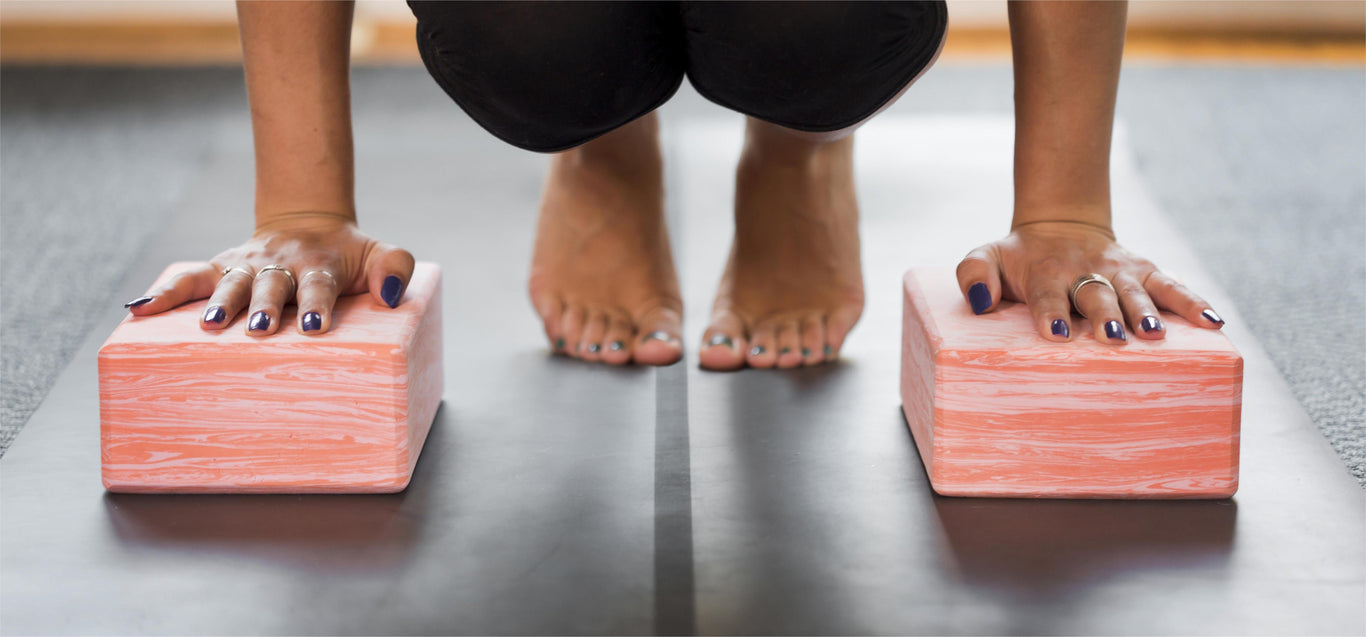
Yoga blocks


Choosing a Yoga Block or Brick
Yoga blocks are simple pieces of equipment, but there is more choice than you might expect. Most are rectangular and can be turned onto different sides, giving you a few height options without needing another block.
You might place one beneath a hand, keep it beside the mat or use it during a seated position. If the block feels too high or awkward, turn it over or move it closer. There is no need to keep it in one place just because that is where you started.
You will see the words “yoga block” and “yoga brick” used quite a lot. They often mean the same thing, although some sellers use “brick” for a smaller version. The measurements are more useful than the name, so check those before ordering.
Foam, Cork or Wood?
Foam blocks are the lightest option. They are easy to carry to class and are lightweight.
Cork blocks feel heavier and more solid. The surface usually shows the natural grain. The colour and texture may vary a little from one block to another. Small marks or differences in the cork are not necessarily faults.
Wooden blocks are heavier again. They have a hard surface and may come with rounded corners or a smooth finish. The type of wood and outer coating can vary, so it is worth reading the individual product information.
There is no single material that will suit everyone. Foam is convenient to carry, while cork and wood are usually better suited to someone who does not mind the extra weight.
Check the Size
Yoga blocks can look almost identical in photographs. One block may be taller and the other may be wider.
This is especially important when you already own a block and want another one to match. Two products described as blue foam blocks, for example, may still differ in size, shade or shape.
Look at the edges as well. Some blocks have rounded corners, while others have straighter sides. The close-up photographs usually make this easier to see.
One Block or Two?
Some listings are for one block, while others include a pair. A photograph showing two blocks does not always mean two will arrive.
Check the product description for the quantity before ordering. The blocks may simply have been arranged together for the photograph.
When buying two blocks separately, check that the size and material match. Products from different ranges may look similar online but sit at slightly different heights once they are together.
Taking Blocks to Class
Foam blocks are fairly easy to carry, although two can still take up a surprising amount of room. A bag that already contains a mat, towel and clothing may not have much space left.
Cork and wooden blocks are heavier. One may be easy enough to carry, but a pair will add more weight to your kit.
Have a look at the size of your bag before ordering. Some narrow mat bags have enough length but are not wide enough to hold a full-sized block.
Looking at the Surface
The surface of a yoga block can vary quite a bit, even when two blocks are made from the same material.
Some foam blocks are completely smooth. Others have a light texture pressed into the outside, which may only be noticeable in close-up photographs. A block can also feel slightly different on each side depending on how it has been moulded.
Cork blocks usually show the natural grain of the material. You may notice small flecks, darker patches or slight colour changes. This is normal with cork and means that two blocks may not look the same.
Wooden blocks can have a polished finish, a painted surface or visible wood grain.
Rounded or Straight Edges?
The shape of the corners is another small detail that can be easy to miss.
Some yoga blocks have softly rounded edges. Others have straighter sides and corners that look more defined. You may also find blocks with flat faces but slightly curved edges around the outside.
Two blocks can have the same measurements but still look quite different because of the way the corners have been finished.
Close-up photographs are usually the best place to check this. The main product image may be taken from too far away to show the edges properly.
Solid or Hollow Blocks?
Most foam and cork blocks are solid all the way through. Some wooden or plastic blocks, however, may have a hollow centre or cut-out sections along the sides.
A hollow block can be lighter than a solid one of a similar size. It may also have an opening that can be used as a place to hold it when carrying it around.
The construction is not always obvious from the front photograph. Check the side and underside images if they are available.
Do not assume that every wooden block is solid simply because the outside looks solid. The product description should explain how it has been made where this information is available.
How Firm Is a Foam Block?
The word “foam” does not tell you everything about how a block will feel.
Some foam blocks are made from dense material and hardly change shape when pressed. Others have a little more give, especially around the corners and edges.
It can be difficult to judge this from a photograph. A block may look soft because of its rounded shape but still feel quite firm once you pick it up.
Blocks Sold as Part of a Set
Some yoga blocks are sold on their own. Others come as a pair or as part of a larger set.
A set may include two blocks, a stretching strap, a mat or another piece of equipment. The photographs may show everything together, but you should still check the written description to see exactly what is included.
Sometimes a listing uses several props to style the photograph even though only one block is being sold.
Look for wording such as “one block”, “pair of blocks” or “set includes”. When the quantity is not clear, it is better to check before ordering rather than relying on the photograph.
If a strap or other item is included, have a look at its measurements and material as well. The main product may be the block, but the additional pieces can vary between sets.